
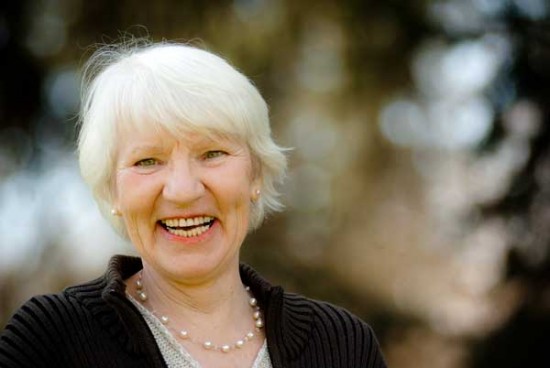
Happy 69 Year Old Lady Has Not Used Money For 15 Years
Heidemarie Schwermer, a 69-year-old woman from Germany, gave up using money 15 years ago and says she’s been much happier ever since.
Heidemarie’s incredible story began 22 years ago, when she, a middle-aged secondary school teacher emerging from a difficult marriage, took her two children and moved to the city of Dortmund, in Germany’s Ruhr area. One of the first things she noticed was the large number of homeless people, and this shocked her so much that she decided to actually do something about it. She had always believed the homeless didn’t need actual money to be accepted back into society, only a chance to empower themselves by making themselves useful, so she opened a Tauschring (swap shop), called “Gib und Nimm” (Give and Take).
Her small venture was a place where anyone could trade stuff and skills for other things and skills they needed, without a single coin or banknote changing hands. Old clothes could be traded in return for kitchen appliances, and car service rendered in return for plumbing services, and so on. The idea didn’t really attract many of Dortmund’s homeless, because, as some of them told her to her face, they didn’t feel an educated middle-class woman could relate to their situation. Instead, her small shop was assaulted by many of the city’s unemployed and retired folk eager to trade their skills and old stuff for something they needed. Heidemarie Schwermer’s Tauschring eventually became somewhat of a phenomenon in Dortmund and even prompted its creator to ask herself some questions about the life she was living.
She started to realize she was living with a lot of stuff she didn’t really need and initially decided not to buy anything else without giving something away. Then she realized how unhappy she was with her work and made the connection between this feeling and the physical symptoms (backache and constant illness) she was feeling, so she decided to take up other jobs. She began washing dishes for 10 Deutchmarks an hour, and despite many were telling her things like “You went to university, you studied to do this?”, she felt good about herself, and didn’t feel like she should be valued more because of her studies than someone working in a kitchen. By 1995, the Tauschring had changed her life so much that she was spending virtually nothing, as everything she needed seemed to find its way into her life.
So in 1996. she took the biggest decision of her life: to live without money. Her children had moved out so she sold the apartment in Dortmund and decided to live nomadically, trading things and services for everything she needed. It was supposed to be a 12-month experiment, but found herself loving it so much that she just couldn’t give it up. 15 years later, she still lives according to the principles of Gib und Nimm, doing various chores for accommodation in the houses of various members of the Tauschring, and loving every minute of it. Schwermer has written two books about her experience of living without money and asked her publisher to give the money to charity so it can make many people happy instead of just one. She’s just happy being healthier and better off than ever before.
All of her belongings fit into a single-back suitcase and a rucksack, she has emergency savings of €200 and any other money she comes across, she gives away. Heidemarie doesn’t even have health insurance as she didn’t want to be accused of stealing from the state, and says she relies on the power of self-healing whenever she gets a little sick.
Living Without Money – Trailer

Article Source – odditycentral.com
Please rate this wake up world post using the stars below. Your ratings will provide us a better understanding of topics that are important to our readers.
We also wish to thank everyone for their continued support of Wake Up World


about 5 months ago
She seems like a really outgoing lady who makes friends easily. I admire the simplicty of her life and while I would not choose to live a similar life, I can see some lessons in simplicity that I can adapt.
about 5 months ago
I read about this woman a few years ago. Amazing to think she’s been successful for 15 years. I was surprised at the number of short-sighted negative comments. Modes of transportation such as cycling or even walking are highly efficient (not to mention, they improve the health). I feel that the true value of items and services becomes more apparent in a barter/trade environment. I’m looking forward to trying out using less money.
about 4 months ago
What if she had started with owning nothing and she had poor health.
I find her to be arrogant and she has no understanding of what causes homelessness.
In a successful community, homelessness would not exist.
about 4 months ago
I would love to live like this.
about 4 months ago
isn’t this basically just communism. While our government may not be properly allocating the taxes it receives, The barter system on a national scale is just not feasible. The fact that this woman is helping out the middle class and retired community and not paying taxes means that she is going against her own original altruistic idea of helping the homeless in her community (taxes help fund homeless shelters and food banks as well as provide income to those homeless folks who can actually make their way to a doctor and get on disability which most of them should be). I would have much rather seen her spend her time to make a change in her own communities government to better provide for these people than trying to make some point that a healthy person can live their life better.
about 4 months ago
Incredible lifestyle! As for the IRS , one embracing a moneyless existence will find fulfillment inside a jail, healthcare, board and lodging all taken cared of.
about 4 months ago
That is great, but she has two children who are old enough to move away, what about people who have little children.I am sure if you grew up this way, yip it is a great way to live but if you haven`t it is hard to change when you have little children. For myself, I sort of live like a freegan, which is hard enough as it is. I wish i could find a landlord in South Africa who, would let me work of my rent every month. Otherwise a very inspiring story of living off the grid
about 3 months ago
Do you think systems change immediately? That just because she is living with other people’s contributions to her care that she is not making a great change and statement towards the possibility of living completely without money? When you or I feel the need to attack something, then we need to examine ourselves. Our judgment, our resistance, our attachments. I enjoyed this article and admired her for leaving the beaten path and doing it successfully. Mendicant monks have lived in similar ways for a long time. Being around someone holy or living in a different way is valuable to those who “support” them.
about 3 months ago
I don’t really find this inspiring. She has willingly become a homeless person that is using the bartering system to not actually be starving on the streets. Yes, it works if you are a 60-something year old, very kind looking lady, but how many of you would open your doors to a 20-something year old with a beard and dreads (just as an example) asking to wash your dishes in return for a place to stay? Before I read this I thought she figured out a way to create some sort of self-sustainable lifestyle that is not relying on other people’s capitalist gains (ie. staying in a house paid for by their jobs and eating their food that they paid for by working for what some people on here consider to be the ‘man’). But good on her for being inspiring to some people.
about 3 months ago
I hate to rain on everybody’s parade, but I’ve actually experienced this phenomenon in Germany first hand, participated in it and known people who went pretty far toward living without money. The truth is that the only way it works is through the money of others. She said herself that when she travels, somebody sends her a ticket. Somebody puts her up in their house or trades her food for her services. The problem is that the other person already bought the thing they gave her. The objects that get traded in these shops (I got what I needed for my first flat in Germany from the local Umsonstladen or “for free store”) are cast-offs from consumer society. Without consumer excess, there wouldn’t stuff to trade for other goods or services. Manufactured goods, food grown abroad, or even regionally, clothing and anything else you need to live a normal modern life cost money, even if that money never passes through your hands. I’ve seen valiant attempts at collective living in the form of “Hausprojekte” (“House Projects”) where people try to live outside the system. I even visited an “Anarchy Camp” in the country where they went so far as to filter rain water but they still drank beer bought from a shop. Without government subsidies in the form of student aid, Kindergeld (money paid to parents for their children) or welfare, a lot of the people living “without” income wouldn’t be able to carry on. What this women does can only happen in a system with enough surplus for people to be generous, not because she’s genuinely living without money.
about 3 months ago
This point has already been addressed in a lot of the initial comments really… all you are saying is that money exists. Nobody doubts that. She is in fact, living without it though; regardless of whether the items she acquires or the services she gets are the product of an burgeoning throwaway capitalist culture, or a socialist society, or a state of anarchy. You are confusing the general with the specific; just because in this current socio-historical moment this method of living SEEMS to depend on other people having money, doesn’t mean that in any way shape or form it does. There are no big enough sample sizes to discover whether it would be a viable alternative to capitalist organisational structure, but the fact it is a separate structure remains. Personally I’m not sure it would work on a global scale, but I’m equally certain that money doesn’t.