
By Jack Kassewitz
Courtesy of www.speakdolphin.com
Researchers in the United States and Great Britain have made a significant breakthrough in deciphering dolphin language in which a series of eight objects have been sonically identified by dolphins. Team leader, Jack Kassewitz of SpeakDolphin.com, ‘spoke’ to dolphins with the dolphin’s own sound picture words. Dolphins in two separate research centers understood the words, presenting convincing evidence that dolphins employ a universal “sono-pictorial” language of communication.
The team was able to teach the dolphins simple and complex sentences involving nouns and verbs, revealing that dolphins comprehend elements of human language, as well as having a complex visual language of their own. Kassewitz commented:
“We are beginning to understand the visual aspects of their language, for example in the identification of eight dolphin visual sounds for nouns, recorded by hydrophone as the dolphins echo located on a range of submersed plastic objects.”
[pro_ad_display_adzone id=”110028″]
The British member of the research team, John Stuart Reid, used aCymaScope instrument, a device that makes sound visible, to gain a better understanding of how dolphins see with sound. He imaged a series of the test objects as sono-pictorially created by one of the research dolphins. In his bid to “speak dolphin” Jack Kassewitz of SpeakDolphin.com, based in Miami, Florida, designed an experiment in which he recorded dolphin echolocation sounds as they reflected off a range of eight submersed objects, including a plastic cube, a toy duck and a flowerpot. He discovered that the reflected sounds actually contain sound pictures and when replayed to the dolphin in the form of a game, the dolphin was able to identify the objects with 86% accuracy, providing evidence that dolphins understand echolocation sounds as pictures. Kassewitz then drove to a different facility and replayed the sound pictures to a dolphin that had not previously experienced them. The second dolphin identified the objects with a similar high success rate, confirming that dolphins possess a sono-pictorial form of communication. It has been suspected by some researchers that dolphins employ a sono-visual sense to ‘photograph’ (in sound) a predator approaching their family pod, in order to beam the picture to other members of their pod, alerting them of danger. In this scenario it is assumed that the picture of the predator will be perceived in the mind’s eye of the other dolphins.
When Reid imaged the reflected echolocation sounds on the CymaScope it became possible for the first time to see the sono-pictorial images that the dolphin created. The resulting pictures resemble typical ultrasound images seen in hospitals. Reid explained:
When a dolphin scans an object with its high frequency sound beam, emitted in the form of short clicks, each click captures a still image, similar to a camera taking photographs. Each dolphin click is a pulse of pure sound that becomes modulated by the shape of the object. In other words, the pulse of reflected sound contains a semi-holographic representation of the object. A portion of the reflected sound is collected by the dolphin’s lower jaw, its mandible,where it travels through twin fat-filled ‘acoustic horns’ to the dolphin’s inner ears to create the sono-pictorial image.
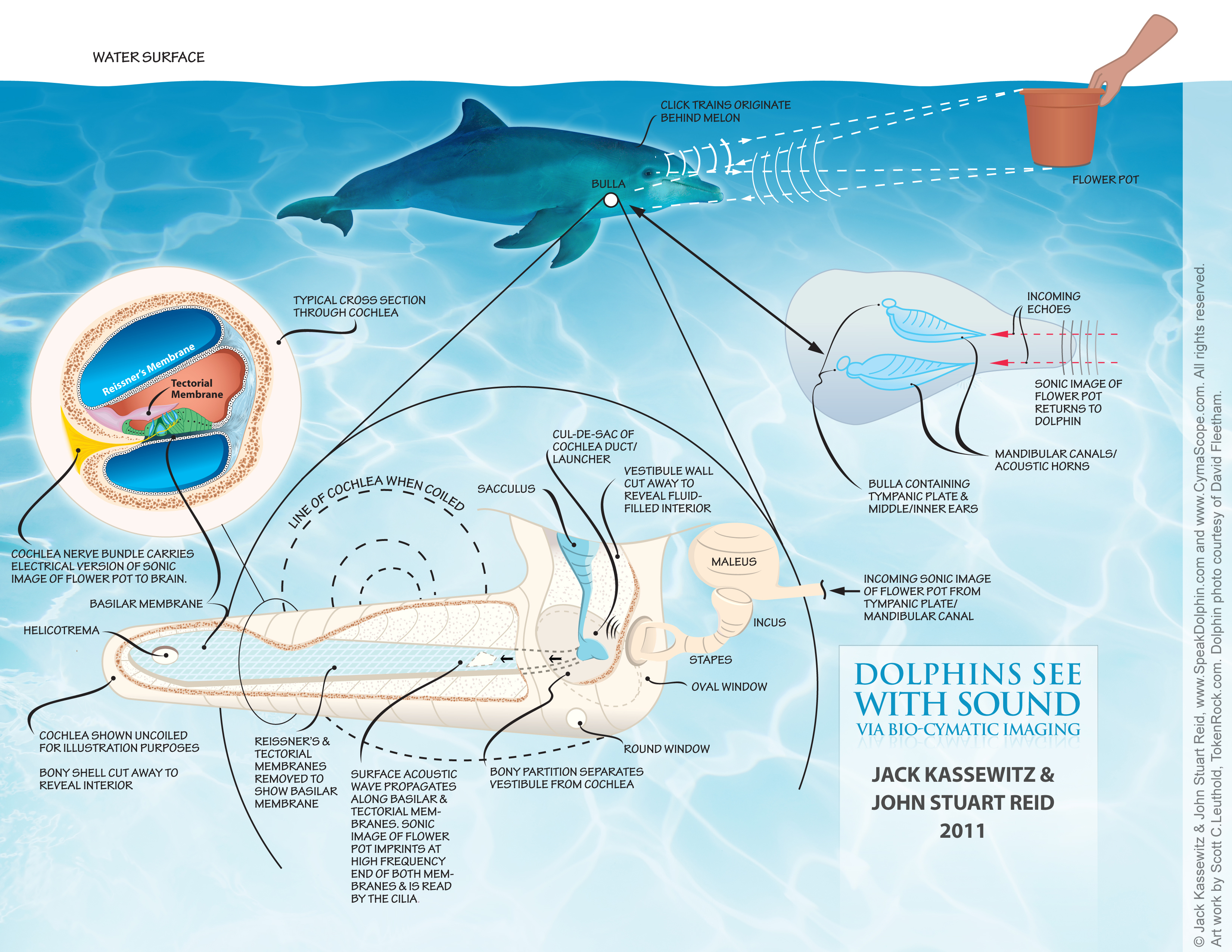
The precise mechanism concerning how the sonic image is ‘read’ by the cochleae is still unknown but the team’s present hypothesis is that each click-pulse causes the image to momentarily manifest on the basilar and tectorial membranes, thin sheets of tissue situated in the heart of each cochlea. Microscopic cilia connect with the tectorial membrane and ‘read’ the shape of the imprint, creating a composite electrical signal representing the object’s shape. This electrical signal travels to the brain via the cochlea nerve and is interpreted as an image. (The example in the graphic shows a flowerpot.) The team postulates that dolphins are able to perceive stereoscopically with their sound imaging sense. Since the dolphin emits long trains of click-pulses it is believed that it has persistence of sono-pictorial perception, analogous to video playback in which a series of still frames are viewed as moving images.
Reid said, “The CymaScope imaging technique substitutes a circular water membrane for the dolphin’s tectorial, gel-like membrane and a camera for the dolphin’s brain. We image the sono-picture as it imprints on the surface tension of water, a technique we call ‘bio-cymatic imaging,’ capturing the picture before it expands to the boundary. We think that something similar happens in the dolphin’s cochleae where the sonic image, contained in the reflected click-pulse, travels as a surface acoustic wave along the basilar and tectorial membranes and imprints in an area that relates to the carrier frequency of the click-pulse. With our bio-cymatic imaging technique we believe we see a similar image to that which the dolphin sees when it scans an object with sound. In the flowerpot image the hand of the person holding it can even be seen. The images are rather fuzzy at present but we hope to enhance the technique in future.

”Dr Horace Dobbs is Director of International Dolphin Watch and a leading authority on dolphin-assisted therapy.
I find the dolphin mechanism for sonic imaging proposed by Jack Kassewitz and John Stuart Reid plausible from a scientific standpoint. I have long maintained that dolphins have a sono-visual language so I am naturally gratified that this latest research has produced a rational explanation and experimental data to verify my conjectures. As early as 1994, in a book I wrote for children, Dilo and the Call of the Deep, I referred to Dilo’s ‘Magic Sound’ as the method by which Dilo and his mother pass information between each other using sonic imaging, not just of external visual appearances, but also of internal structures and organs.
As a result of Reid’s bio-cymatic imaging technique Kassewitz, in collaboration with research intern Christopher Brown, of the University of Central Florida, is beginning to develop a new model of dolphin language that they are calling Sono-Pictorial Exo-holographic Language, (SPEL). Kassewitz explained,
The ‘exo-holographic’ part of the acronym derives from the fact that the dolphin pictorial language is actually propagated all around the dolphin whenever one or more dolphins in the pod send or receive sono-pictures. John Stuart Reid has found that any small part of the dolphin’s reflected echolocation beam contains all the data needed to recreate the image cymatically in the laboratory or, he postulates, in the dolphin’s brain. Our new model of dolphin language is one in which dolphins can not only send and receive pictures of objects around them but can create entirely new sono-pictures simply by imagining what they want to communicate. It is perhaps challenging for us as humans to step outside our symbolic thought processes to truly appreciate the dolphin’s world in which, we believe, pictorial rather than symbolic thoughts are king. Our personal biases, beliefs, ideologies, and memories penetrate and encompass all of our communication, including our description and understanding of something devoid of symbols, such as SPEL. Dolphins appear to have leap-frogged human symbolic language and instead have evolved a form of communication outside the human evolutionary path. In a sense we now have a ‘Rosetta Stone’ that will allow us to tap into their world in a way we could not have even conceived just a year ago. The old adage, ‘a picture speaks a thousand words’ suddenly takes on a whole new meaning.

David M. Cole, founder of the The Aqua Thought Foundation, a research organization that studied human-dolphin interaction for more than a decade said,“Kassewitz and Reid have contributed a novel model for dolphins’ sonic perception, which almost certainly evolved out of the creature’s need to perceive its underwater world when vision was inhibited. Several conventional linguistic approaches to understanding dolphin communication have dead-ended in the last 20 years so it is refreshing to see this new and highly-nuanced paradigm being explored.”
The human capacity for language involves the acquisition and use of a complex system of vocal sounds to which we attribute specific meanings. Language, the relationship between sounds and meanings evolved differently for each tribe of humans and for each nation. It is generally believed that the human language faculty is fundamentally different from that of other species and of a much higher complexity. The development of vocal language is believed to have coincided with an increase in brain volume. Many researchers have wondered why dolphins have brains comparable in size with those of humans, considering that Nature creates organs according to need. The Kassewitz team’s findings suggest the large dolphin brain is necessary for the acquisition and utilization of a sono-pictorial language that requires significant brain mass.
Dolphins enjoy constant auditory and visual stimulation throughout their lives, a fact that may contribute to their hemispheric brain coordination. The dolphin’s auditory neocortical fields extend far into the midbrain, influencing the motor areas in sucha way as to allow the smooth regulation of sound-induced motor activity as well as sophisticated phonation needed for production of signature whistles and sono-pictures. These advantages are powered not only by a brain that is comparable insize to that of a human but also by a brain stem transmission time that is considerably faster than the human brain.
Kassewitz said,
Our research has provided an answer to an age-old question highlighted by Dr Jill Tarter of the SETI Institute, ‘Are we alone?’ We can now unequivocally answer, ‘no.’ SETI’s search for non-human intelligence in outer spacehas been found right here on earth in the graceful form of dolphins.
Full results of this research are available on request. Please email Jack Kassewitz at [email protected]
Article sources:
About the author:
Jack Kassewitz is President of Global Heart, Inc., a non-profit organization that he co-founded with his wife, Donna, in 2001. His greatest focus at this time is Global Heart’s SpeakDolphin.com – Dolphin Communication Research Project – seeking to significantly expand communication between humans and dolphins. Jack’s passion for this research has propelled him to search out and obtain cutting-edge technology for recording cetaceans in the broadest spectrum and highest definition possible.
[pro_ad_display_adzone id=”110027″]
Fascinating study!!! In my story, THE CHRONICLES OF RUBIDJAD ISLAND, dolphins and other sea creatures converse with humans!
Absolutely fascinating!
Many people think in visual-partial terms rather than audio-sequential. I know people who think in terms of music, and others who think in colours.
I think in 3D images, and find our human languages (I know a few) woefully inadequate for accurately expressing my thoughts – it’s too slow (low information density) and I’m too slow at drawing (plus 3D drawing has its problems on 2D surfaces).
Anyway, the point is that the article’s assertion that the dolphin way of thinking is fundamentally different to that of humans is simply incorrect. Humans are not all the same.
I envy the dolphins for having worked out a way to communicate that’s fast and descriptive, suitable for their 3D environment. Awesome!
Wow dude, you really are a serious windbag.
your a windbag for callin him a windbag
You’re a windbag for calling the person who called him a windbag a windbag.
So, dolphins “see” by means of echolocation… and then they’re capable of “speaking” that image to eachother? Making sounds to reproduce the same image? That’s amazing…
Although this article seems to be making that claim, it’s not warranted by the study as far as I can see. It does seem to show that dolphins can understand the environment without generating clicks, if they rely on reflections from clicks of other dolphins.
An analogy might be two people moving around in the dark, one with a torch. Of course they both see images generated by reflection of the one torch light. But that doesn’t mean that the reflections are being used to communicate. And, of course, anyone could interpret recordings of those images. None of this means that this is a natural communication method. It is of course common, since the advent of cinema and TV. But even cave paintings require technologies that aren’t available to dolphins.
Now, it’s conceivable that dolphins can reproduce reflected sounds, and use them to communicate. For example, they might ‘click’ a sound that looks like a reflection of a predator species in order to intimidate a mate, or one that looks like a reflection of a prey species. But there’s no evidence of that in this article: merely reporting of a suspicion that this might happen.
I don’t think you read the same article as the rest of us…
“Kassewitz then drove to a different facility and replayed the sound pictures to a dolphin that had not previously experienced them. The second dolphin identified the objects with a similar high success rate, confirming that dolphins possess a sono-pictorial form of communication”
You missed his entire point… his analogy of one person holding a torch and others able to see the reflected light besides the holder was perfect… The replaying of an image simply means they interpret reflected sound waves in the same way… not that they are passing sonic images around using them to communicate… as I read the article, I had the exact same thought… that the researcher was essentially a buffoon…
I’m not catching the point the two of you seem only to be implying. I feel like if you had a completely sound argument you took the point(s) all out and just left the evidence. so what was the point? that dolphins if given the choice would take Wheaties over Total despite having less nutritional content due to it’s partnerships with professional athletes? I’m completely lost…
I don’t see it mentioned anywhere in the article that the experiments shows the dolphins have the ability to produce these images, only that they are capable of understanding them. It is like saying people beam pictures of flowers to each other because both recognize a photograph of a flower. It is possible the experiment covered this aspect, but I don’t see it mentioned in the article, only speculation that the dolphins can reproduce the sonic-imagery.
This is fantastic! We (and they) can learn all sorts of interesting things with even rudimentary interspecific communication, and with more sophisticated communication skills on one or both our parts, the results should be mind-blowing. The conservationist in me thinks the first goal should be to find out how to communicate a “DANGER – AVOID” signal to the dolphins and to get the means to communicate that out to all of the fisheries that have a dolphin by-catch problem.
amazing study!
and despite of all that, there’re a lot of cruel imbecile people in the world who keep killing these unimaginable creatures.(
Interesting. Over 30 years ago, I wrote a short sci-fi piece for a HS class assignment based on the premise that we had learned how to communicate with dolphins, and used the knowledge to enslave them.
There is a veneer of technical sounding language in this article, but it doesn’t seem like real science- at all.
The validity of these claims is questionable at best.
what part of scientific proof that was detailed above didn’t you understand ?
To me it seems very straight-forward. The sensors were explained very well too. I really don’t see what you mean. They did not say it’s all there is to know about it.
I am confused about a detail. If I read it correctly, the sonic imaging occurs because of the clicks and the number of clicks per second would correspond to a frames per second in a film, allowing for processing that produces the phenomena of continuity and persistence. But does this mean that a mute dolphin is at the total mercy of the uncalibrated ambient sound? That a mute dolphin would be effectively sound-blind? They would still have ordinary vision, but that would be a significant limitation.
That’s great! But then you go back and watch The Cove and think: “that’s horrible! we’re killing a species so close to our own!” Although, if they are really capable of communicating with dolphins, perhaps someday they’ll be able to warn them to stay away from dangerous areas such as Taiji.
I think (from hours and hours of experience alone with a dolphin and her mate) that the researchers got on to only a fraction of what communications dolphins do. I believe they communicate emotionally similar to how we can if we try to do so withOUT words. The fraction that the researchers picked up on is tied to echo location on steroids compared to our use of that function. I suggest they try to do yoga meditation in front of the dolphin and observe how they can know how “deep” they are able to meditate. We are definitely not alone.
We need to seek support of enterprises to protect the animal Kingdom given the fact it continuously shows (proves) that animals have the capacity of abstraction, of emotional memory being able to overcome their instincts setting them at a “higher” level in terms of “civilized” creatures. We need therefore to seek Governments and Firms who can Sponsor communication movements to teach society why we have to protect the animal kingdom.
I’m waiting for the day when the dolphins tell us what to do with ourselves. I’m betting it won’t be nice 😉
Hahahhahah! Good one Robin!
Very interesting. Not sure what to think. Got led here from some weird place on the net.
So is this true and they communicate images? This of course doesn’t mean they’re intelligence. Some birds and mimic people’s words and “sound” intelligent. It has to be established that dolphins are not simply copying what they see and relaying it sort of like how a parrot might, but that they’re instead fundamentally understanding what they’re seeing and relaying in an intelligent manner. For example, dolphins might be able to take a “picture” of the mona lisa (naturally, water-proof!) and “share” it with others, but if they can’t create a mona lisa on their own then all the copying in the world is useless.
Okay, but what I really want to know is whose idea was it to use a flowerpot as a test piece?
The audacity of this guy to think he can emulate the sonic picture generated within the dolphin’s brain…
LOL
Only stupid humans a.k.a. homo stupidus creatures can think they’re alone in the midst of life around them.
Quote:
“Our research has provided an answer to an age-old question highlighted by Dr Jill Tarter of the SETI Institute, ‘Are we alone?’ We can now unequivocally answer, ‘no.’ SETI’s search for non-human intelligence in outer spacehas been found right here on earth in the graceful form of dolphins.”
Animal Intelligence
When will animals first gain national citizenship and rights?
Wow! Since I’ve been reading about the amazing intelligence of animals, I started wondering when the first animal will be given citizenship and rights, just like a human. Here are some stories that have made me wonder this:
A horse that can open locks:
Crows can use 3 tools in sequence correctly without training. Crows are the first non-human example of an animal correctly using 3 tools in sequence like this:
http://www.youtube.com/watch?v=41Z6Mvjd9w0
A 1908 study showed raccoons were able to open 11 of 13 complex locks in fewer than 10 tries and had no problems repeating the action when the locks were rearranged or turned upside down:
http://en.wikipedia.org/wiki/Raccoon#Intelligence
N’kisi, an African Grey Parrot, had an English vocabulary of about 950 words and had even learned how to conjugate verbs he had never been taught: for example, having never been taught the past tense of “fly”, he said “flied”:
http://en.wikipedia.org/wiki/N'kisi
also:
http://en.wikipedia.org/wiki/Bird_intelligence
Oh, I almost forgot this one: “Past ready”!
http://content.time.com/time/magazine/article/0,9171,2008867,00.html
And this one: an elephant painting a picture of himself:
http://www.youtube.com/watch?v=oAvJElLFAEQ
Maybe at some point humans will learn enough “words” used by different animal species that we can have a voice translator app for our phones that will act as an interpreter as you talk to a bluejay or a dog, with the app translating what each of you is saying for the other.
Here’s a list of the top 10 voice translator apps:
http://www.inman.com/2011/06/10/top-10-language-translation-apps-ipad-and-iphone/
Maybe when we figure out how to do cybernetic communication directly between brains, whether human brains or animal.
A dancing dog:
https://www.facebook.com/photo.php?v=519401451415799
General article on animal intelligence:
http://en.wikipedia.org/wiki/Animal_intelligence
So, here’s what I’m wondering:
– What will be the first animal to be granted citizenship to a human nation?
– When will it get citizenship?
Hmm…